Personal Observations and Comments Concerning the
History and Development of IBM
The
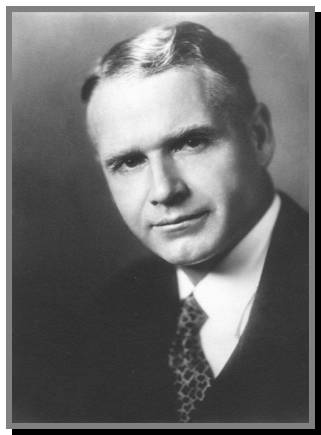
Perspective of Walter D. Jones - an IBM customer, salesman and executive.
Toronto,
August 1944
Contents
We knew in our family that my mother's father, Walter Dickson Jones,
had been an IBM employee since before the First World War and that he had
" … run the European operation for Thomas Watson." My mother had many
stories of their privileged lifestyle in Paris in the early 1930s. Beyond that,
what "WD" actually did for IBM was a matter of some speculation.
Various biographies and anecdotes filled in a few of the details. In 2001 Edwin
Black (no relation) published "IBM and the Holocaust - the Strategic
Alliance Between Nazi Germany and America's Most Powerful Corporation." I
bought the book and sure enough, Walter Dickson Jones popped up in several
places. I learned that WD had been on the board of Dehomag, the German
subsidiary, that he had been the IBM emissary at the January 8, 1934
Lichterfelde plant opening ("Repeatedly using Nazi buzzwords for economic
recovery, Jones made clear that Mr. Watson agreed to the new construction
…") and that he had been Watson's point man for the battle between
Heidinger and Watson over control of Dehomag. I emailed the IBM Archives in New
York with a request for other information that might help me round out the
story of my grandfather's career. They sent the article, written by WD in 1944,
that is transcribed here as well as representative correspondence. I rewrote
the story into the first person and took out some of the more tortuous
circumlocutions.
Don Black - Regina, August , 2001
Early
Days In Cleveland
My first contacts with the Company were in 1909. I
was Chief Clerk, Journal and Statistical Division, American Steel and Wire
Company in Cleveland. American Steel
and Wire was a constituent company of the United States Steel Corporation. I
made a trip to Pittsburgh to study the application of the Hollerith machines at
the Carnegie Steel Company. I decided that the machines could be useful at the
American Steel and Wire Company.
I ordered the machines through Phillip P. Merrill,
who was a combination salesman and repairman at the Tabulating Machine Company.
Merrill was in charge of the lakeshore installation of the New York Central
Railroad.
As I recall, ours was the only installation in
Cleveland at this time. After considerable delay, the machines arrived in the
summer of 1910. When the crates arrived, Mr. Merrill was notified. He connected the machines up to an
electrical current, came over to my desk and shook hands. Before he could get
out of the office I asked him what help might be given in regard to starting
the work. He replied that he was only required to connect the machine to a
suitable source of electrical energy. He assumed no further responsibility,
except to repair the machine, if it got out of order. That was the established
policy of the company at that time. This, by way of contrast to the Company's
current policy of assistance and help to customers. However, the machines were
successfully installed and proved to be a more efficient way of handling the
statistical and accounting work.
Two years later, at the solicitation of Mr. Merrill,
I entered the employment of the Tabulating Machine Company as a salesman.
Shortly thereafter, I offered a suggestion regarding a back-stop on the
punching machine. Information received from head office in Washington however,
was to the effect that this young man "should confine himself to selling,
not inventing, with the customary sarcastic reference that the idea was as
"useful as a button on a shirt-tail."
At about the time I joined the Company in 1912, a
decision had been made to divide the United States into districts. District
Managers were appointed in Philadelphia (T.J. Wilson), New York (Hyde), Boston
(Sayles), Cleveland (Merrill), Chicago
(Hayes) and Denver (Stoddart). The District Managers attended the annual
meetings, either in Washington or New York. Information regarding the
activities at the conferences was not divulged to salesmen. At that time it was
a small, but close Corporation!
The first convention of the Tabulating Machine
Company Division was held at the Vanderbilt Hotel in New York in December of
1915. Much to the surprise of the District Managers, and even more so to the
salesmen, a telegram was received from Mr. Watson notifying District Managers
that they were to bring the salesmen to New York to the annual convention. This
was the first mark of progress in the Company's affairs, since my connection
with it. This action brought the salesmen together as a team for the first
time. Mr. Watson will never realize the
uplift and inspiration that he imparted
to the salesmen of that day as a result of his conduct at the meetings. (Some
District Managers, however, were a
little confused!)