The Canadian Tabulating Machine Company came into
being as follows. St. George Bond, a Canadian from Toronto who lived in
Philadelphia, obtained the Philadelphia franchise from Dr.. Hollerith prior to
1910. But in a year or so it went bust, to the tune of 15 or 20 thousand
dollars. As a gesture, and more or less out of sympathy, Dr. Hollerith gave
Bond a license to operate in Canada in 1910 and Bond then formed the Canadian
Company. The terms of the contract
called for a 20 per cent royalty payment on all rental revenues. The machines
wee to be supplied by Hollerith at cost and second hand machines were to be
shipped at nominal value. Larry Hubbard, who had received his training with
Hollerith in Washington was engaged to run the Company. The first order he took
was from Mr. Fletcher of the Library Bureau and the machine was installed in
Toronto in December of 1910.
Hubbard then set up an office in Montreal on St.
James Street. In 1911 he wrote one contract, in 1912 four, in 1913 three - all
of these are still users. By 1918 he had 41 customers with an annual rental of
about $60,000.
As I recall, prior to 1914 Canada was operated from
the United States as part of the territory of the Rochester agency of the ITR
Company of New York. From time to time, James, the Rochester manager, sent
salesman up to Canada to get business. The late Jack Barry perhaps spent more
time in Canada than any other IBM salesman. Mr. Barry later became Sales
Manager of the ITR division and when he died in 1929, had become the Sales
Manager for the entire Heavy Duty scale division. In 1914, when Mr. Mutton was
placed in charge of the ITR Company, the representation from Rochester was
discontinued and Mr. Mutton bought his time recorders directly from the parent
Company in Endicott. Later, when the Scale Company was also placed under Mr.
Mutton, it was recommended to Mr. Watson to get out of the plant on Royco and
Campbell Avenue and build a new one.
Mr. Mutton presented a plan to Mr. Watson of adding another story to the
plant. Mr. Watson accepted Mr. Mutton's
advice and it was only after a period of 20 years or so that the present plant
began to outgrow its usefulness.
In 1915 and 1916, and even before, competition
between the dial recorder and the time recorder was tough and considered a
serious factor in Canada. The dial
recorder was a sturdy and satisfactory machine. I found this out in spades when
I tried to trade 50 of them out of the Angus Shops of the CPR for new machines
of ours. Some of them had been in use for over 35 years and were still going
strong. The dial recorders were manufactured by the W.A. Wood Company of
Montreal. Mr. Mooser, later factory manager in Toronto built them. Mr. Mutton,
who was an astute and shrewd businessman, made strong recommendation to Mr.
Watson that the Company buy out the Wood Company factory and patents. This was
done in 1917.
During about five months of 1918, St. George Bond,
who has since died, acted as sales manager of the Tabulating Machine Division
under the late Mr. Frank Mutton. Mr. Mutton was appointed Vice President and
General Manager of the three divisions of the CTR Company of Canada and the ITR
in the summer of 1918. It was then called the Computing Tabulating and
Recording Company Limited of Canada, a name later changed to International
Business Machines Co. Limited.
To go back a year or so, by December of 1917 the
Tabulating Machine Company of Canada was unable to meet its payments for the
purchase of machines. While Mr. Watson had given Mr. Bond ample time to arrange
his finances to meet his obligations, he was unable to do so and some form of
relief had to be sought.
Mr. Watson then engineered the plan of forming a
Stock Company in Canada. This company would acquire majority rights in St. George Bond's interests in the
Tabulating Machine Company of Canada and the Davidson rights in the Computing
Scale Company of Canada for cash/stock in a new company. This was done in the
summer of 1918. During these meetings,
several amusing incidents occurred. Once, in the middle of the lawyers
wrangling about values and amounts claimed by interested parties, Mr. Mutton
demanded that the people representing the New York interests, Mr. Rogers and
Mr. Houston, meet with him outside the room on a matter of great importance.
Rogers and Houston found Mr. Mutton at the end of the corridor, seated on a
radiator with his legs crossed. His important question involved the
advisability of having his name placed on the letterhead as the General Manager
of the new Company.
In 1926 and 1927, all of the stock owned by the
public was bought up by the corporation. Rogers and St. George Bond were the
agents acting on behalf of the corporation in this transaction. Since that
date, the Canadian Company as been 100 per cent owned by the International
Business Machines Corporation of New York.
Between 1935 and 1939 the income and profits of the
Canadian Company increased 70 per cent. From 1935 to 1943 the income and
profits increased 800 per cent. While it is true that this remarkable growth
has taken place during the war years, it should not be overlooked that the
extreme confidence, both on the part of business and the Government in Ottawa,
led them to place their orders with our Company.
This confidence was based upon the performance of
the machines, as well as the character and ability of the personnel in the
Canadian organization. These people, through lean years and good years have
worked conscientiously in the building of the good name of IBM in the minds of
customers and prospects. It may also be
said that the Government, in searching for the mechanical means to fill its
needs during the war for accounting and statistical requirements has, with one
exception, considered only our Company as a source of supply.
The prestige of the Company was greatly increased by
Mr. Watson's visits to Canada prior to and following 1937. In 1937, as each
year thereafter he met the most prominent men in Canada, commercial,
educational and governmental. He also made many public addresses. On September
2nd of 1941 he took the entire executive staff of the IBM Corporation to the
Canadian National Exhibition. The Company was being honoured at the CNE's
International Day. That evening Lily Pons and Lawrence Tibbett gave a concert
at the Band Shell in front of some 60,000 people. This large audience was addressed by Mr. Watson, Mrs. August
Belmont and myself. At that concert, a generous donation of $10,000 went from the Company to the Canadian Red
Cross to help in the war effort. While this large sum was given without
publicity, the kind comments of the officer and directors of the Red Cross
would have been heart warming to any IBM executives, could they have heard
them.
During Mr. Watson's visits many changes were made to
the form and conduct of the business. In the latter part of 1937 he purchased
the property on King Street. The executive offices were separated from the
factory and IBM executives could be at the heart of the city's financial
district.
In the very early days, there were only three employees
of the Company, all located in an office at 15 Alice Street. I believe that
Alice Street became Teraulay Street and the original site is now a parking lot.
In December of 1938 Mr. Watson purchased the Beaver Hall property and the
office building erected on this site is considered to be the most modern of its
kind in Canada. Having one of the Company's executives living in Ottawa where
he could mix it up with the various government departments and personnel from
1935 onwards also helped the Company build up its business in Canada.
Another factor which had a lot to do with the
welding of the Company personnel into a
united team was Mr. Watson's authorization for the purchase of a country club.
This property, purchased in 1942, consists of 100 acres just outside the city
limits. It's fully equipped and has a play house and playgrounds so that the
entire family can enjoy themselves. Mr. Watson authorized the purchase of an
additional 100 acres adjacent to the Country Club. This property crosses the
main feeder line for the CNR and will make a suitable site for a manufacturing
plant as and when needed in the future. It is cheap land at the price and is
currently being farmed by the farmer who sold it to us, on an annual rental
basis.
The
Story of the British War Orphans
Following the German invasion of France in May and
June of 1940, when England was in great danger, Mr. Watson, with characteristic
thoughtfulness for others, cabled
Stafford Howard, Managing Director of the ITR in London, inviting the
wives and children of employees to take refuge in Canada at the Company's
expense.
In response, nine mothers and nineteen children
arrived in Toronto on July 5th 1940. This first group was followed by a second group of three mothers
and four children on October 9th of the same year. They were
temporarily housed at the Sisters of St. John the Devine hostel at 49 Brunswick
Street in Toronto.
Mr. Watson then authorized the purchase of lake
frontage at Bronte, about 28 miles west of Toronto. This property consisted of
eight acres, including fruit and market garden and two fine houses. When Mr.
Watson and Mr. Nichol visited Toronto on July 15th, 1940 to inspect
the property, and make the necessary arrangements, certain reservations on the
part of some of the evacuees caused him to abandon his plan - and the property
was sold without loss.
The evacuees were the lodged in boarding houses in
the west end of Toronto and suitable arrangements were made for schooling etc. Now that return permits
are being granted by the British government, some of our families have returned
home and there will no doubt be others in the near future.
The policy inaugurated by Mr. Watson to encourage
employees to mix in community affairs and join business and trade associations
has had much to do with establishing the prestige and reputation of our Company, as well as the development of
the individual. The Company's employees represent a standard of intelligence
and character which fits them all for such a roll. The very nature of the business
permits and demands constant development along business lines. This is
characteristic of the successful IBM man and stamps him with qualities of
leadership, both in public speaking and leadership. He attracts attention
wherever businessmen gather.
In the United States and Canada you will find IBM
men in the forefront of sales executives' clubs chambers of commerce,
manufacturers associations and boards of trade. Honours and preferments seem to
come to them naturally. This is the natural product of the educational system
fostered and promoted by Mr. Watson. The Company is no place for the bounder or
the philanderer. We have had some in the business, but they don't stick.
At the time when Mr. Watson took over the management
of the CTR Company in 1914, it is safe to say that every member of the sales
force of the CTR thought that the Company was on the upswing of an unending
period of growth, and the equipment consisting of the No. 15 Key Punch, hard
punch, vertical sorter and the non-automatic, non-lister tabulator would do the
trick.
As a matter of fact, the initial impetus given the
business when Dr. Hollerith installed the large machines with the Railway and
Insurance companies, was petering out and the Company was running into shallow
waters. The progress made in the book
keeping, adding and listing machines, and the improvements made by a competitor
with a similar machine, was bidding fair to eliminate us as a serious
competitor in the office specialty field.
The Company was going down hill instead of up and if
it had not been for the new machines which the Engineering and research
Departments had developed under Mr. Watson, the Company would have been limited
to certain kinds of statistical work. These new machines such as the Horizontal
high speed sorter, Printing Tabulator with Automatic Group Control, Electric
Key Punches and many other devices, have made possible the growth of the
Company.
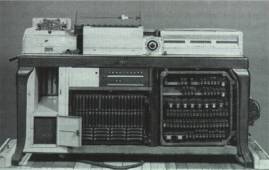
An early
combined tabulator/sorter
Concurrently with the improved machines, the sales
department was increased. All salesmen participated in a comprehensive
educational system on our products. A refresher course for the older salesmen
was also developed.
The Company had a new birth and was ready for larger
service to the business world, beyond the dreams of the original founders of
the Company.
The
Story of Tauschek in Europe
The advent of Tauschek into the electrical
accounting field makes interesting reading.
Tauschek, a young Austrian living in Vienna, was a
clerk in a bank in Vienna in 1926 or 1927 or perhaps earlier. One of the
clients of the bank was the Powers Accounting Company. One of Tauschek's duties
at the bank was to scrutinize cheques, including those from the Powers
Accounting Company. In the case of the Powers Company, two signatures were
required.
On one occasion, Tauschek failed to note that only
signature was on a cheque destined for New York. The cheque came back and Tauschek took it over to the Power's
office to have it signed. Tauschek had never seen Power's accounting machines
and he asked the company manager explain to the machines to him.
Tauschek made
one or two visits to get additional information, and in the course of
conversation, he found that the mechanical tabulating machines were being sold
in Europe for between $15,000 - $20,000. Tauschek decided that the price was
too high and that a cheaper machine could be built which would do the same
work.
He then got in touch with patent offices in Germany,
Great Britain and the United States. Tauschek had copies of all patents which
had been issued concerning tabulating machines sent to him. He then took a
course in English so that he could read and comprehend all the material.
As a result of investigations, research and model
building, he secured patents from German, Great Britain and the United States
in and around existing patents. He then manufactured a model key punching
machine, a sorter and a tabulating machine, the principles of which were
slightly different from the existing types.
With this beginning, Tauschek entered into a
contract with the Rhein Metalls Company to develop his patents and build the
machines for commercial use. This contract was entered into around 1929.
Dehomag, our German subsidiary, was somewhat
disturbed by Tauschek as a potential competitor and was in favour of
negotiating with him.
During a trip to Europe in 1929, Mr. Watson had
Rottke (of Dehomag) and Tauschek come to London, to meet with himself, Mr. Jennings and myself (as
the newly appointed European General Manager).
The negotiations were held in Grosvenor House in London. After a week of
negotiating the IBM Company bought out
Tauschek's patents, and the models he had developed, with the exception of one
set of machines which Tauschek presented to the Vienna museum. As well, Tauschek secured five years of
employment with IBM, seven months of each year to be spent at the IBM labs in
the United States. As additional consideration, Tauschek also agreed to
unreservedly convey all his ideas and patents with regards to electric
accounting machines.
At about the time of the end of his contract with
IBM, it was discovered that he had proceeded with certain patents secretly
concerning the development of an electric eye principle. He had not turned this
work over to IBM, as per the terms of his agreement with us. Tauschek was
brought sharply to task by the Company but it began to look as if the only way
the Company could get redress would have been through the courts. In the midst
of negotiations, he fled, returning illegally to Germany. The rumour was that
he had been called back to Germany to complete work on a new type of machine
gun that he had developed for the German government.
There are a number of reasons which led up to the
increase of the capital structure and the consolidation of the three companies
in Germany: Dehomag, Ingemag (the scale company) and the Sindelfingen Scale
Factory. The capital of these companies
was nominal. I think that Dehomag's amounted to something like 300,000 marks.
We had kept the capital of the companies low on purpose, because the German
government taxed on capital stock. In fact, the two scale companies had never
shown a profit. Dehomag was different though and in 1932 and 1933 its profits
soared to four and five times its capitalization. The German Treasury began
careful scrutiny of firms such ours and of course this scrutiny was aided by
supplementary information provided by Nazi observers. The observers were
assigned by party leaders to all industrial plants throughout Germany. There
was always one observer keeping track of things and in some cases two or three,
depending on the size of the plant.
Dancing
With the Devil - Nazis On Staff
At Dehomag we had a young Nazi by the name of
Fredericks who was on staff as an 'observer'.
I learned that Fredericks was one of the party of six Nazis who broke
into General Von Schleicher's residence during the infamous June, 1934 "Night of the Long Knives" purge
of Ernst Rohm and others.
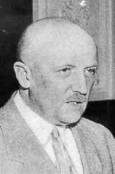 General Von Schleicher
Fredericks and the others executed Von Schleicher
and his wife in cold blood.
The fact that Dehomag was paying out annual
dividends many times the amount of its capital had resulted in certain
questions being asked by the German Treasury. At the same time, the Dehomag
Company had been made the target of abuse and criticism from the Nazi
controlled press throughout Germany on the grounds that the use of Dehomag
electric accounting machines threw clerks out of work. In government offices in
Hanover in 1932 civil service employees went on a bit of a rampage and
partially destroyed their newly installed Dehomag machines. This incident
received widespread publicity.
About this time our agent in Munich, a Mr.
Pappenburg had caused Rottke and Heidinger some concern due to reports coming
in to the Munich office concerning Pappenburg's unexplained absences from
work. They asked me if it would be all
right if they put a 'tail' on Pappenburg. As they seemed quite worried, I
agreed to their request. The reports we got back showed that Pappenburg was a
very active Nazi and that his absences were due to his attendance at various
conferences and meetings of the Nazi party. This gave Mr. Heidinger the idea of
using Pappenburg to meet Hitler at Hitler's Nazi headquarters. He wanted to
establish friendly relations with Hitler and the Nazi party so that the party
would discontinue its attacks on Dehomag. It is my understanding that Heidinger
became a Nazi party member at the meeting.
The result of this meeting relieved the Company from
further investigation by the German government and hostile criticism of the
Company by the Nazi controlled press stopped. In addition, the capitalization
of the German companies was increased to 7,000,000 marks. All the losses at the
Sindelfingen plant and at Ingomag were also capitalized. Over the next period of time, Dehomag and
the Sindelfingen plant became the only active units in Germany. The Small Scale
Factory (Ingomag) gradually folded. Interestingly, in 1934 the output of the
Sindelfingen plant was 85 per cent weaving machines - most of which were sold
to the Russian and German armies for the making of military uniforms.
Mr. Rottke did not become a Nazi until 1933. In the
fall of that year I called a meeting in Paris of all European managers which
Mr.Rottke attended. During the meeting Mr. Rottke took me to one side and said
that a demand had been served on him by the Nazi Party to become a member. He
wanted my advice and he showed me the letter and stamped self addressed
envelope that the Nazis had given him. He told me that he had been given 24
hours in which to answer their demands. From his manner, I surmised that he was
hoping that I would advise him not to join. But this was clearly a matter for
Rottke and his family to decide, on their own. I understand that he mailed his
application to join the Nazi Party the next morning.
Collecting delinquent ITR and EAM accounts was a bit
different from collecting delinquent accounts in other businesses due to the
close and continuing relationship that existed between the Company and its
customers. Instead of pressure letters and calls from lawyers representing the
interests of head office, it was customary to have the EAM Manager or salesman
assume the role of bill collector when an account was past due.
This often placed our representatives in a difficult
position and frequent dunning calls to collect the money did not tend to
improve his standing with his customers.
Coming out of the twenties, there were a great
number of EAM customers who were delinquent. In addition, the accounts with the
government in Washington had become hopelessly in arrears for a number of
reasons, one of which was the failure of the billing department to put in
sufficient information to allow proper accounting to be made for the public
monies expended. Something had to be
done and it was decided to make a change.
The late W. C. Sieberg, who was the General
Bookkeeper of the EAM Division, was given the job. His first task was to straighten
out the Washington situation and then he was to move on and clean up the rest
of the accounts throughout the country.
Mr. Sieberg spent about four months in Washington and got the Government
accounts up to date. At the same time that Mr. Sieberg was chasing down delinquent customers, we brought in Mr.
Brown to do Sieberg's old job. Brown had been an accountant at a factory and we
brought him in so that he would gain a thorough knowledge of head office accounting,
which he could then take back to the
factory.
By way of commentary, it is my opinion that a good
EAM accountant, of broad commercial training, should always work as the liaison
man for the collection of delinquent accounts, rather than depending on the
salesman to do the collecting. The Company has ever, to my knowledge prosecuted
a customer for the non-payment of an account. Hence, it becomes a matter of how
and when to make a compromise agreement or settlement with a customer.
To an ingenious negotiator, it is almost always
possible to effect some form of agreement to protect the Company's interests,
and to ensure that the customer does not disregard his obligations to pay. In
certain cases, treasury stock or bonds have been accepted. I cite the case of a
Canadian aircraft company who was in arrears for over 18 months in 1936 and
1937. I interviewed the Treasurer of the company and we reached an agreement
whereby they would pay us monthly installation charges and the balance would be
held in suspense until they were able to make payments on the old balance. Any
payments made by the company were applied against the oldest balances. Within
two and a half years the account was brought up to date and it has not been
delinquent since.
A
Historical Note on the Bull Company
It would seem proper to have some reference in the
historical data about the development of the Bull machine. The following is a
very sketchy outline and it should be supplemented by more accurate and
detailed information.
Dr. Fredrik Rosing Bull, a Norwegian, developed the
machines. When he died, he left his plans, his notes and diaries and the
machine's specifications
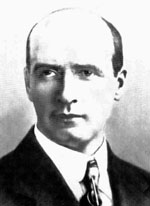 Dr. Bull
and whatever patents he had, to the University of
Oslo where they lay dormant for a number of years.
Emile
Genon, who later became our agent for Belgium, had been in the office specialty
business for years as a Belgian reseller of Elliott-Fisher and Underwood
calculators. In the course of his travels, he found out about Dr. Bull's
machines and that the University of Oslo had done nothing with them. Genon saw
possibilities. He got a group of interested investors together in Paris.
Members of this group included the auditor for the French Railway (a large
customer of ours) and general in the French army. Genon got enough money together to purchase all rights pertaining
to the Bull machines (except for Scandanavia) from the University of Oslo. As I
recall, Genon told me that he was able to buy these rights for $10,000.
The models were shipped to Paris, and under the
General's supervision, a limited number were built and installed in customer's
offices. According to all reports, they worked quite well. The Sorter was of the horizontal type and
was unusually light, in fact, about half the weight of our machine. The
Tabulator-Printer had a speed of about 230 cards per minute for listing and
adding. The type bar was of the rotary
principle. Under Genon's management, the Bull Company bid fair to make inroads
on the established business of the
Company.
At my suggestion, Dehomag sent two of their representatives
to investigate the machines. These representatives reported to Heidinger and
Rottke that the machines had considerable merit. The Bull machines were
demonstrated at the Paris Exposition in 1931 and attracted considerable
attention.
With this background, when Mr. Braitmayer visited
Europe in 1933, arrangements were made for him to meet with the Bull group in
Paris, and certain tentative negotiations were carried on in a regard to a
possible acquisition by our Company of the Bull Company
Genon
was later employed by our Company as our representative in Belgium. In November
of 1935 IBM Mr. Watson proposed to buy
all Bull assets for 2.8MF (including patents). In December of 1935 Emile Genon transferred 86% of Bull AG to IBM.
The next day, the Callies family proposed a new stock subscription of 6MF,
approved by Marcel Bassot, to avoid an IBM take over.
Costs
and Profitability During the War
On March 2, 1943 the Canadian Company was asked by
the Department of Munitions and Supply to submit a statement of income, costs
and profit on any installations that might be considered war business with the
Department. This request was later broadened to include all government business
which could be classified as war business. The object of the inquiry was to renegotiate
our contracts with all government departments to establish fair and reasonable
profits on installations arising out of the war and to arrive at the portion of
the profit to be refunded.
At that time, the Canadian Company purchased EAM
equipment from the Parent Company on the basis of flat factory cost. We
therefore brought to the attention of Department officials that we were unable
to submit an accurate statement of costs. This flat factory cost did not
include administrative overhead, the costs of engineering, patents, development
or research. The Department indicated that it would be perfectly reasonable to
include any such items in our estimate of our costs and that the Department
wold have the right to scrutinize such items to determine whether they were
fair and reasonable.
On June 4, 1943 our Controller, A. L. Williams,
furnished a statement that showed the amount of such expenses, applicable to
the Canadian Company, expressed in terms of per cent, would approximate 5 per
cent of the total revenue of the Canadian Company for the year 1942.
The increase in cost of the over-all picture of the
Canadian Company, had the expense been included, would have amounted to
$167,687 (Gross Canadian income - $3,563,917) of which about $50,000 would be the
amount to be added to the cost of our war installations with the Government.
(Government installations in round figures, $1,000,000 per year or
approximately 25 per cent of total installations).
In view of the known losses we would sustain when
the war ended by discontinuances and cancellations, plus the unamortized value
of the machines which would be returned to us, I did not consider that the
figures being presented were fair for the Company. It was not enough for us
just to build up our cost figures.
I therefore decided to fight for the inclusion in
our costs of the 25 per cent royalty paid by other subsidiary companies. We were finally able to convince Department
officials to agree to the inclusion of this 25 per cent fee and an agreement
was reached by May of this year (1944).
On $1,000,000 of revenue, the royalty cost will amount to $250,000 as
against $50,000 had we decided to include IBM Corporation overhead as an item
of cost.
Historical
Data - Census Machines
Perforated papers and cards were used to select and
control patterns in the weaving industry in the eighteenth century. This
principle was improved by Joseph-Marie Jacquard, a French inventor of Lyons
prior to 1806. The introduction of these 'Jacquard Looms' caused riots against
the replacement of people by machines.
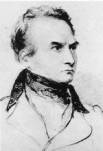 Babbage
It remained for Charles Babbage, an English
mechanic/mathematician to experiment with the principle of punched holes in
relation to a calculating machine. Babbage got government support for his
machine in 1822, but his 'Difference Machine' was never completed.
In the 1850's and 1860's, the development and use of
punched holes in paper for player pianos and organs was a great commercial
success.
It is perhaps with some of this background in mind
that Dr. Hollerith seriously considered adapting the principle of punch cards
for the compilation of the US census of 1860, from a chance remark made to him
by a young woman. He had been called to Washington in the early '80s to act as
a special agent in the Census Department. During a pleasure cruise on the
Potomac with Census Department co-workers, a young woman asked Hollerith:
"Why don't some of you men devise a card for the census work by punching
holes into it and making a machine do the rest of the work?"
By 1889 Dr. Hollerith had perfected and patented a
card with 12 rows of 20 positions for holes, to be punched on a Pantagraph
Keyboard Punch. His tabulator was similar to a printing press with the cards
being fed by hand and a handle which operated the press, thus allowing the pins
to press through the card. Wherever these pins went through the hole in the
card, electrical contact was made in a mercury cell below. The result was
registered in one of forty different counters. An attached sorting machine
consisted of a horizontal box with two rows of thirteen compartments, Each
compartment had a lid controlled by a magnet. This machine was controlled by
wires from the tabulator. To prepare for the next sort, the operator removed
the card from the tabulator and dropped the card into the compartment through
which the tabulator had just sent an impulse to cause the lid to open. The
compartment lid was then closed by the operator.
In April of 1889 a Commission was formed to advise
Mr. Porter, Superintendent of the US Census, as to the methods to adopt of
tabulating census data. To this Commission, three schemes were presented. Mr.
Hunt's scheme proposed to transfer the details given on the census enumerator's
schedules to cards, distinctions being made in part by the color of ink, and in
part by written notations, the results being reached afterwards by hand sorting
and counting. Mr. Pidgin proposed a scheme whereby chips would be used. These
chips could then be duly sorted and counted by hand. Mr. Herman Hollerith then
made his presentation, described above.
The three proposals were then put to the test in
four enumeration districts in St. Louis. It was found that the time occupied in
transcribing the enumerator's work (10,491 inhabitants) by the Hollerith method
was 72 hours and 27 minutes. The Hunt method took 144 hours and 25 minutes, Mr.
Pidgin's plan took 110 hours 56 minutes. He time occupied in tabulating was
found to be as follows:
·
Hollerith's
electrical counters - 5 hours 28 minutes
·
Hunt's
slips - 55 hours, 22 minutes
·
Pidgin's
chips - 44 hours, 41 minutes.
That settled it. Hollerith got the contact. The
Commission also estimated that based on America's population of 65,000,000, the
savings with the Hollerith machines wold amount to over $600,000. As a matter
for the record, that estimate was based on an average of 500 cards punched per
day, while 700 per day turned out to be the average - the savings were 40 per
cent more than expected. By way of contrast,
the work of tabulating the 1890 census was finished in ten months. The previous
census, undertaken in 1880, still was not fully tabulated when the 1890 census
began. In fact, some of the data from the 1880 census was never tabulated -
this despite a workforce of 47,950
women tabulators working in the daytime and 32,935 men tabulators working at
night (figures from "Electrical Engineer", November 11, 1891 pp.
522).
Dr. Hollerith's connection with the U.S. Census
Department did not continue very much longer after the completion of the 1890
census. The relations were broken, as I understand it, through differences that
arose between himself and government officials or official. He withdrew and the
department started to build its own machines, incorporating the Hollerith
principles in the machines that they built. James Powers, a foreman in the
Census Department, developed a key punch which the Department adopted. Mr.
Powers, of Jewish origin, continued his developments and research work with the
result that he developed a horizontal sorter and printer-tabulator, both
mechanical, on which no patents had been taken out by Dr. Hollerith. Dr.
Hollerith had considered three methods for a power supply when he perfected his
machine; electrical, mechanical and compressed air. He took his patents out on
the electrical method - leaving others the option of developing machines with
compressed air or mechanical power.
This was the start of the Powers accounting machine.
Dr. Hollerith went on to assist in the census
processing for many countries around the world. The company he founded,
Hollerith Tabulating Company, eventually became one of the three that composed
the Calculating-Tabulating-Recording (C-T-R) company in 1914, and eventually
was renamed IBM in 1924.