Embarrassing incidents occurred from time to time
while prospecting customers in the Cleveland area. One such incident was to have the General Manager or the
President of a company reach into his desk during a sales call and pull out a
four or five line letter from Dr. Hollerith.
The letter would say something to the effect that "In answer to
your letter of today, relative to the use of our tabulating machines for your
business. I can say only that your company's scope and activity is not
sufficiently large enough to warrant an installation of our machines."
This usually proved a hard one to hurdle!
The remarkable growth of the Company following the
radical departure from the non-lister to the printer justified the time, effort
and expense which Mr. Watson incurred in making this change. Mr. Watson
engineered this change in spite of the hostile and sarcastic criticism of Dr.
Hollerith who was opposed to a printing
tabulator.
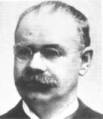 Herman Hollerith
The thought that the non-lister was superior to the
printer was so ingrained into the minds of the salesmen that it took quite a
period of time before the printer's obvious superiority was acknowledged. The
printer made complete reports without transcription, which was not the case with
the non-lister. Thus, hand printing and transcribing was eliminated. The
printer then became an integral part of the accounting system, rather than a
machine to grind out statistics.
In 1914, the Vacuum Oil Company of Rochester New
York, one of the Standard subsidiaries, discontinued its contract with us. The
reasons for this discontinuance was that the salesman who took the order had
designed a faulty product code. After the monthly sorting of the cards, the
product groups would have to be re-arranged by hand before tabulating. The
Company found that the work involved was greater than if they had just posted
the information by hand in the first place. Not surprisingly, the machines were
thrown out.
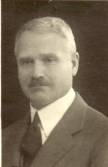
Walter Dickson
Jones ca. 1920
I had been working on Standard Oil Company of Ohio
and had almost got an order when news came of Vacuum's discontinuance. I found
out the facts about the faulty Vacuum code and then went to see the President
of Standard Oil, Mr. Coombs. I explained the situation to him and he agreed
that I could work with the Company Controller, Mr. Connelly, to determine a
more logical product code arrangement. I worked with Connelly for three solid
weeks and coded every one of their products in the natural and proper
arrangement. I got the order and installed the machines. Thereafter, Connelly
was considered the product coding authority amongst the various Standard Oil
companies.
One of the toughest pieces of prospecting that I
encountered had to do with a steel company in Youngstown, Ohio. After having
called numerous times and been turned down by a number of top officials, I
finally got a response from the Assistant-Treasurer. He set a time for a
meeting when we would discuss my proposition. Imagine my surprise when I
arrived at his office for the meeting and discovered that the sales
representative for our chief competitor was also on hand for the same meeting.
Mr. X, the Assistant Treasurer, said "Now, I have called you men in to
give both of you a chance to explain what your respective machines can do for
me. Now Mr. Jones, you tell us what your tabulating machine will do. When you
finish your story, then Mr. Doe will explain his proposition. I will then
decide which is the better of the two proposals. This sales call was made at a
time when the Company's stock was pretty active on the market and he telephoned
to one of his officials to see if they had the latest quotation. Apparently the
stockbroker's offices were pretty busy and he couldn't get the information.
After he had asked me to start my talk I got up and said that we could not get
anywhere with two salesmen wrangling over the respective merits of their
machine, and that I was willing to let my competitor have his say first.
I took the elevator to the ground floor, just at the
time when the 3 o'clock edition of the paper was being brought in. I quickly
got one of the paperboys, gave him a quarter and told him to take a paper up to
Mr. X right away and to tell him that Mr. Jones had sent it up to him. After
about an hour, I was invited into Mr. X's office. Mr. X was very cordial indeed
and thanked me for the newspaper. This little incident paved the way for very
cordial relations with Mr. X. I finally
had the satisfaction of taking his order.
In 1912, a very limited and small commission plan
was introduced to supplement the salesmens' earnings. This scheme continued
until sometime in 1914. Speaking from a salesman's point of view in the
Cleveland district, I never knew the basis for the payment of the commissions. It did not concern me as most, if not all of
the commission went to the District Manager. It was discontinued because it was
not a well thought out plan.
It might be of interest to record how it came to
pass that the late Mr. Gershom Smith, comptroller of the Pennsylvania Steel
Company, Steelton, Pennsylvania, came to be appointed General Manager of the
Tabulating Division of the newly formed Computing-Tabulating-Recording
Corporation. Mr. Smith, while a good accountant and user of tabulating
machines, was quite unfitted by experience and training to head this division.
The facts as related to me by a friend to whom Dr. Hollerith had told the
incident, are as follows.
Charles R. Flint (the trust specialist who set up
the CTR in 1911)and
a Director visited Dr. Hollerith in Washington, to get his recommendations in
regard to someone to operate the Tabulating Division. It happened that a short
time before, Mr. Smith had presented Dr. Hollerith with a large framed
photograph of himself. In Dr. Hollerith's words, "As I raised my eyes to
Mr. Flint, they happened to rest on the photograph of Gershom Smith. I thought
to save myself a lot of bother, I might as well recommend him, for I fully
expect to buy this division back from CTR before my retainer expires. In the
meantime, Mr. Smith could not do much harm to the business, even if he could
not do much good, and I will be kept in touch with developments."
The young men (some of whom became District
Managers) whom Dr. Hollerith had trained in Washington to repair the machines
adopted his views. This was at a time when the Doctor was making his first
inroads with the railways and the insurance companies. The Doctor looked upon
and considered his customers to be clients, in a true professional sense,
rather than in a commercial sense. Hence, it was the rule to speak of customers
as clients. Another deeply rooted idea which came from Dr. Hollerith was that
the machines were to be used solely for statistical purposes, and they had no
place in the accounting field as such.
None of the young men who had been trained by Dr.
Hollerith had much, if any, accounting experience and it was therefore natural
that they did not see the sales opportunities for the machines in the
accounting field.
It was perhaps because of my background of
accounting experience and the fact that when I ordered the machines for the
American Steel and Wire Company, they were installed for accounting work
primarily. In that installation, the statistics were a by-product of the
accounting work.
In every order I took as a salesman in the Cleveland
District, I would always work in some accounting features. My theory was that
there was less chance of a discontinuance if the machines were part of the
company's accounting processes, rather than merely being used for the gathering
of statistics. I always insisted that the installation be under the control of
the company's accountant - this assured greater accuracy and it also
established friendly relations with the accounting department.
In the natural development of things, my
discontinuances were very few. In 1915 I took twelve new contracts and
installed them personally. There was not a discontinuance in my territory for
the whole year.
About twenty years ago (1924), Jim Bryce was
developing a high speed calculating machine, which was later put in the E.A.M.
line as the Multiplier. On account of
its speed and capacity, there were doubts raised as to whether such a machine
could be used commercially by existing customers. The sales Department was
consulted as to its potential. I was drawn into the discussion and asked for an
opinion. In conversation with Mr.
Bryce, Mr. Wilson and Mr. Lamotte, I pointed out that while there was little or
no work in the present installations that could support such a multiplier,
there were fields that we had not touched, where the multiplier would be
invaluable.
I cited the case of the municipal tax bill. The bill
must show the valuation of the property, which is calculated by three different
rates, i.e., school rate, municipal rate and the county rate. I estimated there
were between five hundred and three thousand cities in the United States who
could use a multiplier to advantage.
This angle interested Mr. Bryce, as well as the Sales Department with
the result that Mr. Lamotte asked me to write out my ideas about municipal tax
accounting. My ideas were turned over to the Research Department. The subject
of municipal accounting was one with which I was quite familiar, having worked
four years for the Town of Westmount, writing out by hand, and calculating, the
tax bills for the entire town.
In 1928, while having lunch at the Bankers Club in
New York with Mr. Mack Gordon, one of my old Cleveland customers, I was
discussing with him the marvel of being able to send Mr. Watson's photograph
through telegraph wires to Chicago.
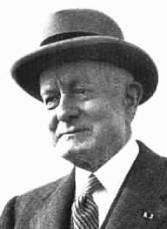 Thomas Watson Sr.
The thought occurred to me that if a photograph
could be sent through space, it should also be possible to transfer a figure
from a document through a punching machine to a hole in a card and thus
eliminate the human error in punching.
In other words, the transferring of facts and
figures from the document of original entry would be done electrically, thus
completing the cycle of electric accounting. Upon my return from the Bankers
Club, I dropped into Mr. Watson's office and found him in conversation with the
late Andrew Jennings and explained my idea. Mr. Watson's comment was "If
it can be done, it will be worth a million dollars to the Company." I was
told to discuss it with Mr. Bryce. After talking it over with Mr. Bryce an
appropriation was issued for the experimental work to develop an electric eye
principle, which Mr. Bryce thought would be the best medium to experiment with.
The Scale Company in France (a division of the
Dayton Testut Company) was sold because it was a losing venture. This was also
true of our experience with the German Scale Company. At the same time, there
was no better scale manufactured in France or Europe than the Dayton Testut
Scale.
However, the marketing and sale of the machines was
done through agents and salesmen in every corner of France. These salesmen
invariably operated without regard to Company policy, which resulted in
shortages and losses. The agents to whom the scales were shipped on consignment
were careless handlers of the Company's property, to say the least of it.
The late Mr. Jennings considered that the business
was profitable. This was so because, as he explained to me, what they lost in
agency operations, they more than made up for in the sales from the factory to
the agents. Shipments from the factory
to the agents were billed at full sales price and naturally showed a profit
over and above cost. I pointed out to Mr. Jennings that this was only a book
profit which only became a real profit when the agents paid in cash for the
machines that we had shipped to them. I also pointed out that the Company was
carrying the agents' accounts receivable which had not, and would not be paid
because all the agents were broke.
The arrangement with the Testut group in France
provided a clause that said that they agreed not to enter the computing scale
field and our Company agreed not to enter the non-computing scale field, both
light and heavy capacity. I subsequently found out that one of our strongest
competitors in the sale of computing scales in France and Italy was a company
financed and operated by the French Testup group. This constituted a breach of
their contract. At that time, the Dayton Tetsup Company was losing money, so I
came up with the proposition to sell the French group the Dayton Testup
Company, good will and patents, up to the point of sale, rather than enter suit
against them. Permission to negotiate was given by New York.
I approached Colonel Desrouche, a director of the
Dayton company, but not connected with the competitive scale company and gave
him to understand that an agreement might be reached. He in turn mentioned the
possibility to Mr. Testut and Colonel Montgomery, directors of the Dayton
Testut and principals in the competitive scale company. After two years of
thinking it over the French group stated that they were willing to purchase the
Dayton Testut.
On the date of consummation we had gathered in the
office of our attorney, Mr. Marion, and had agreed to the amount of stock that
we would take in the new Company and the cash consideration. There was only one
thing still up in the air; the verification of the count and quality of
machines in the hands of the agents scattered all over France. It had been
tentatively agreed that we would each appoint a representative who would make
visits to the various agencies and arrive at a valuation of each agent's stock.
In case of a dispute, a referee would be called in to arbitrate the difference.
The amount involved in the inventory of machines in the hands of the agents
amounted to about 3,250,000 francs.
Much to my surprise, Mr. Cadier, General Manager of
the Testup group made a proposition that if our group would consider a discount
of 600,000 francs, that they would settle in cash for the inventory, sight
unseen. In view of what I knew about the scale business in the United States
and Europe, and the irresponsible and careless way in which agents operated, I
considered this a good proposition from our point of view and accepted it.
Subsequent findings of the Testup group, when they checked on the agents'
inventories, proved that the inventory of scales when they finally got hold of
them showed a shrinkage greater than the 600,000 francs discount which was
agreed to.
The Tabulating Machine Company (TMC) was never
legally established as an operating company in France. It operated in the
offices of S.I.M.C., which was the French Company, at 29 Boulevard Malesherbes.
The work of rendering the bills to the customers
throughout all Europe, outside Germany, and the collecting of the amounts due,
was done by employees of the SIMC Company.
A fee was paid to SIMC for this work by the Tabulating Machine
Company. TMC maintained no bank account
in Paris or France. The payments for rentals by customers in Europe, outside of
Germany, were made out in US dollars, and sent to Paris. They were then sent by
registered mail to New York. The Company paid no taxes of any kind in France. I
was assured by the late Mr. Jennings that this arrangement was entirely legal.
One of the employees of SIMC, for reasons of
personal spite, denounced the TMC to the French Treasury Department in 1933.
The result was that two officers of the French Treasury Department appeared in
my office one day and demanded full information in regards to the operation of
the TMC, from the date of its inception.
As this looked to be serious business, I stalled the agents and made an
appointment with them for the following day. I went down to see Mr. Marion, our
solicitor, and reviewed the case with him. Mr. Marion stated that in his
opinion the French tax authorities had grounds to impose a tax, and its size
depended upon the nature of our defense. He offered his assistance, but I had
found from contact with him that he lacked force as a negotiator and besides,
his attitude showed that he had already prejudiced the case. I then got in
touch with New York and asked that Mr. M.G. Connaly be sent to Paris to assist
in the defense of the Company's interests.
In the meantime the agents, armed with the authority
of the French law, conducted a cursory investigation. During this preliminary
investigation I got as much information out of them as possible in order to get
a line on the scope of, and pertinent facts by which they hoped to prove their
case. When they presented their initial findings, they had arrived at a tax of
between 50 and 60 million francs. They were very decent however, and when I
explained that a representative from New York was coming over to go in to the
matter in greater detail with them, they agreed to hold off making an arbitrary
tax demand until the representative arrived. As a result of Mr. Connaly's very
proficient presentation of our case, together with whatever assistance I was
able to provide, the tax was reduced to about 2,300,000 francs. This sum
included all penalties.
The Valtat Wrongful Dismissal Suit
When I arrived in Paris in
1930, I was told by Mr. Jennings of the Valtat suit.
Valtat was an EAM salesman who had been dismissed by
SIMC. He promptly brought suit against the French Company for unjust dismissal,
claiming two or three hundred thousand francs damages. Jennings then brought
suit against Valtat for one million francs on the grounds that he had perfected
his process of card printing on the Company's time and property and in
violation of his contractual agreement, he had failed to turn his invention
over to the Company.
Before the case was tried, I went with Mr. Delcour
to interview our attorney, a Mr. Garcier. Mr. Garcier explained to us that
while he had not actually read the files, he would do so an hour or so before
the court opened and, in his own words, "Soyez tranquille. I will win the
case. Valtat's lawyer is young and inexperienced and anyway, I know the judge
who will hear the case." His unjustified optimism was rudely upset
however, when the judge listening to the pleadings of the two attorneys did not
even send it to a jury. Instead, he rendered a fast decision in favour of
Valtat, costs and damages against us. Valtat had been illegally discharged and
he had not been paid the full indemnity allowed under French law.
M. Garcier immediately appealed the case and then
asked me for instructions. I consulted with Mr. Porter, an American solicitor
living in France. Mr. Porter advised us not to press the suit against Valtat, but to negotiate directly
with him.
Valtat seemed to be a fairly decent Frenchman. His
story, later confirmed, was to the effect that he had worked as a salesman for
SIMC. During that time he had had a good territory, sold more than any other
salesman and had made good commissions. He said that he had been quite
satisfied with his relationship with the Company. On a Monday morning he
received a letter signed by Mr. Delcour, telling him that his territory was
reduced and that his commission rate was reduced, effective the first of the
next month. He protested to Delcour and was fired.
I had several interviews with Valtat and finally
convinced him to withdraw his suit for a settlement of 50,000 francs. This left
him in a friendly mood for the negotiations that subsequently took place in New
York where the Company brought the rights to his punch card printing process in
all countries except France.
I am still convinced that his
process has merit.
Alone and with small capital he was able to devise a
process to stick two pieces of wrapping paper together, cut and print them and
call it a tabulating cad. His card worked and he sold them for less money than
our card and our competitor's card and still made money. It was free from
carbon specks and slime holes, did not warp and withstood humidity as well or
better than our cards.
The following illustrates the mentality of a certain
type of French government official, and their attitude towards what is commonly
known as 'graft'.
One day in 1932 I received a phone call from Mr.
Lawrence, a salesman of SIMC, our French Company. He wanted me to authorize a
payment of 30,000 francs to a French government official. Lawrence told me that this payment would
secure an order for six complete installations in six different departments of
the French government. This one order
would provide us with an annual income of 30 million francs. Lawrence further
stated that once the order was signed, we would also be required to make a
one-time payment of 3 million francs - to be divided amongst the higher-ups. My
reply to Lawrence was "Not one centime!" Not surprisingly, the order
went to a competitor.
In due course, a million and a half dollars worth of
competitor's equipment arrived at LeHavre. It was unloaded and placed in a
warehouse. The French government refused to accept delivery. The equipment remained in storage for a
couple of years at which time our competitor tried to sell it throughout Europe
for half price.
Graft was very flagrant and open in the Balkan
countries - no doubt a hang-over from the days of Turkish domination. Graft was
even carried to the point where a Government official would give an order to a company
for goods which the Government had no intention of buying. The contract would
carry stiff penalties for contract cancellation. When the official cancelled
the order, the penalty would be paid by the government and divvied up amongst
the interested parties.
When I arrived in Paris, the late Mr. Jennings
explained to me that all tabulating machine price lists for the Balkan
countries were 10 per cent higher than
the rest of Europe. This 10 per cent
represented the amount of money that we would return to the 'interested
parties.' He even had a rubber stamp made up for Balkan price lists which said
simply "10% of prices added."
When I became European Manger, I countermanded these
instructions. I gave orders that EAM prices were to be the same in the Balkans
as in the rest of Europe and no orders to be accepted on which the Company was
required to pay anything other than the salesman's regular commission.
The Block Brun Company - Warsaw
The Tabulating Machine Company agent in Poland was
the firm of Block Brun Company, appointed by the late Andrew Jennings in 1927
or 1928. The principals were highly respected and wealthy, third generations
Moscow Jews. The headquarters of the firm was still in Moscow. The Warsaw
branch was managed by Stefan Brun, one of the partners who looked after the EAM
business.
Mr. Jennings was quite frank in stating one
particularity about Block Brun. The firm were our agents for EAM equipment. At
the same time, they were the agents for typewriters and adding machines of a
competing company. This was rather disturbing news to me and I made an early
trip to Warsaw to see how they operated. My investigation convinced me that the
two agencies were run by separate organizations of Block Brun. I was also convinced that they were honorable
in every respect to their obligations to the two companies.
The following is an example of just how square they
were. I was acting as chairman of a
German banquet at the Hotel Adlon in 1933 when a messenger brought in a note
from Stefan Brun saying that he had to see me at once on urgent business.
I excused myself to Mr. Rottke. Mr. Brun told me
that while he was waiting in an anteroom of the competitor's office, he
overheard their managers and patent attorneys discussing their plans to bring a
patent suit against Dehomag. The facts were passed on to Heidinger and Rottke
and a quick investigation was made by Dehomag. After an interview was held
between Dehomag attorneys and the competitor's attorneys, the proposed suit was
shelved. Brun had nothing to gain from
this personally, but his actions portrayed his loyalty. It is to be hoped that
he and his family were able to get back to Moscow before the German holocaust.
The following illustrates
the vindictive streak in certain types of Germans.
Kaun, manager of the Sindelfingen Scale plant in
Germany had been very leniently treated by Mr. Watson. However, matters finally
came to a head and he was let go. Under German law, Kaun was entitled to a full
year's salary and undisputed right to continue living in the house he occupied
on the Company's property. When he vacated the house at the expiry of a year,
it was wrecked from attic to cellar. He used axes, saws and hammers to destroy
the plumbing, the fixtures, the wiring, the stairways - even the plaster on the
walls.
The Company believes in the salvage of men and
materials. The following incident bears out the wisdom of this approach.
Ferrara, of Italian parents, was brought from
Brooklyn to Milan to strengthen the EAM division of the Italian Company.
Vuccino, Manager, assigned him to a territory in Milan. For some reason or
another, he did not do well. After four or five months, Vuccino wrote to me to
say that he was letting Ferraro go. I wired to him to hold off until my next
visit to Milan.
When I got to Milan a week or two later I found that
people in the Italian organization were hostile to Ferraro because he came from
the States. I arranged for him to be transferred to Genoa as a full time salesman
with a period of six months to show his mettle. In less than four months he had
secured a large contract from Standard Oil and was on his way. I met him a few
years ago in New York and he was still with the Company.