|
What is IBM subsidiary
DEHOMAG's responsibility for the uses of its equipment leased to the German
government for the German censuses? What type of technical help did DEHOMAG
provide when Hollerith technology was used in the concentration camp system?
Holocaust scholars and
other historians believe further study is warranted about these and other
questions. It's a topic where there's a great deal of interest, observed
Holocaust museum curator Luckert. What did they [DEHOMAG directors] know?
What was their position on it? And
what was the nature of the contractual relationship between the IBM parent
and its subsidiary, and what control could the U.S. firm have exerted during
Nazi rule?
IBM Corp. has never
answered those questions: A senior corporate IBM archivist in Somers, N.Y.,
Robert Godfrey, said that "IBM's archives are open to anybody who wants
to come," but that "I don't have any documents here that relate to
the Holocaust." He said IBM has not issued a position paper or any
statement on DEHOMAG, or any response to the Holocaust museum's exhibit. "The Germans did use the DEHOMAG
Hollerith. That's about all I know," he said. Only a brief, puzzling
explanation is offered in IBM's internal publication The Story of Computing in Europe by John Connolly. Listed in a chronology
of events is this description for 1939, "Due to war, connections between
DEHOMAG and IBM Corp. (especially for technical information) ceased."
Milton says, "The few
contacts we tried to have [with IBM] were very unsuccessful. What we tried to
do was to find out if they had punch cards, old punch cards that might show
us the way this works. They had nothing; they had long since been shredded.
No one saves punch cards, and no one has such a collection."
IBM was displeased that its
logo was shown on the DEHOMAG Hollerith displayed at the museum: "We
learned that IBM considered the logo inappropriate on principles of fairness
and artifacts' integrity, because the logo had been added to the equipment by
IBM after the war when DEHOMAG was renamed IBM Germany. However, IBM still
owned the company that made it, whether it was called DEHOMAG or
Hollerith," Milton said.
By mentioning IBM in its
Hollerith display, the exhibit raises questions, whether intentionally or
not, about IBM Corp. and DEHOMAG's responsibility for how its leased machines
were utilized. Observes former museum
historian Luebke, now at the University of Oregon, "The point of that
exhibit has been predictably misunderstood as an accusation thrown at IBM, as
if to say, 'Bad, bad IBM, you were complicit in the Holocaust.' But what the
exhibit is about is the degree to which the Nazi state availed itself of
up-to-date technology to classify its citizenry according to the racial
categories of the state.
"Were they complicit?
Sure," Luebke says. "What does it mean? That is harder to
say." Noting that at least a half- dozen other American multinational
companies maintained operations in enemy countries, although profits remained
blocked during the war, he says, "It is harder to point the finger at
IBM as compared to companies producing armaments for warfare and profiting
from slave labor."
As for the exuberant
statement from DEHOMAG director Heidinger praising the Nazi regime and census
program, Luebke says, "That doesn't make him an Eichmann, either.
There's a big gap there between someone who sees a business opportunity and
someone who participates in a process of genocide."
Says Milton, "We were
never out to harass any corporation. The aim here was to tell a story of how
people, companies and even foreign companies are made complicit for multiple
reasons in a process that would have taken place, perhaps, more slowly, but
certainly would have happened in Nazi Germany. Certainly, you would have
needed more manpower to manipulate cards by hand. What this machine does is
it makes it faster. It mechanizes it. And it's part of the industrialization
of mass murder."
If Hollerith leases
machines to the German statistical office, is Hollerith responsible for what
the German statistical office does with that information? poses Holocaust
museum curator Luckert."The German Hollerith company may have produced
the cards, but they wouldn't have been involved in [selecting ] the groups
for identification."
Luckert also said,
"It's very difficult to show a link between knowledge within the
corporation of the actual killing process. Information goes to agencies
involved in the killing process. But that doesn't mean the information
gatherers are part of that killing process. They supply the
information." Luckert distinguishes between American companies that had
wholly owned subsidiaries in Germany, such as IBM, Frigidaire and General
Motors' Opel, and companies like I.G. Farben, which actually utilized
prisoner slave labor in the manufacture of its products. Clearly, IBM Corp. had a keen interest in
its German subsidiary's growing business before World War II, when Jews and
other groups were already being disenfranchised from German economic life and
persecuted. Military intelligence and Justice Department Warfare Section
documents maintained at the National Archives II in College Park, Md., show
that IBM Corp. was actively involved in the decision-making as DEHOMAG
rapidly expanded facilities and capabilities to meet the push for the 1939
census. Correspondence between the two entities mainly focuses on the need
for increased factory space and equipment, and not on the applications of its
machines. IBM sent over U.S.-based
personnel to help with the surge in German business, according to IBM's
published history: "By 1936, a program to supply Germany with engineers
with punched card machine experience starts with the transfer of Walter
Schaar from U.S.A. to Germany. Otto Hang followed in 1937 and Erich Perschke
and Oskar Hoerrmann in 1939."
And before the war, in 1937,
when Jews and dissidents were already being oppressed (concentration camps
existed as early as 1933), IBM Corp. President Thomas J. Watson Sr., then
president of the International Chamber of Commerce, accepted the Merit-Cross
With Star from Chancellor Adolf Hitler, "honoring foreign nationals who
have made themselves deserving of the German Reich." To protect overseas
investments, Watson had been actively campaigning for World Peace Through
World Trade.
While in Berlin for the
occasion, Watson met with Hitler and reported to the press afterward that
Hitler personally assured him that "there will be no war. No country
wants war; no country can afford it. Certainly that is true of Germany."
Watson also said he was "impressed with the simplicity and sincerity of
[Hitler's] expression."
"It indicates a
sentiment that was noncritical of what was going on in Nazi Germany,"
Milton says of Watson's award from Hitler. "It indicates a willingness
to overlook certain problems. Your willingness to accept this [award] already
tells you something very compromising about the thought process in corporate
ideology."
Watson's son and eventual
successor at IBM, Thomas J. Watson Jr., writes in Father, Son & Co.: My Life at IBM and Beyond, "Dad's
optimism blinded him to what was going on in Germany.... Dad believed his
German businessmen friends, who assured him they had Hitler in check. A lot
of people made the same mistake."
Watson's son also describes
meeting up with his parents in Berlin during this time; clearly his parents
knew of the oppression directed at Jews: "Mother told us that her
friends the Wertheims, who owned one of the biggest department stores in
Berlin, were leaving the country. In the summer of 1935 theirs had been one
of the businesses hit when Nazi gangs ran wild in Berlin's streets, smashing
the windows of Jewish-owned stores. The Germans we knew pooh- poohed the
incident at the time saying, 'Oh, it's too bad, but you know how young people
are,' but Mother had been shocked."
Watson Jr. also writes, "I
also visited the Japanese embassy. It was a beautiful house, and we stood in
the garden sipping tea while a German diplomat told us proudly that the place
had belonged to a rich Jew who had fled the country. Nobody took exception,
but I wondered how the Jewish man felt about having his house taken over. The
callousness of the Germans made me very uneasy."
Watson Sr. did not return
the Merit Cross of the German Eagle to Hitler until June 6, 1940, following
the invasion of France, but well after the beginning of World War II with the
invasion of Poland on Sept. 1, 1939.
IBM's publication describes
a power struggle before the war between DEHOMAG's director Heidinger and the
parent company. IBM's president Thomas J. Watson Sr. sent a representative in
1940 to negotiate with Heidinger, who wanted more control over DEHOMAG and
believed that as Germany expanded, so would his company. This
representative/attorney is praised by Watson as the bravest man in IBM for
saving DEHOMAG from Heidinger control and takeover by the Nazis during the
war.
A U.S. military
intelligence interview with a captured DEHOMAG branch manager (1944)
indicates that the German subsidiary employed about 2,300 people in 1944. The
company ran training schools before and throughout the war for customers
intending to operate the machines themselves.
In addition to leasing
equipment and labor, knowledge of IBM business practices would indicate that
subsidiary employees would have provided technical support through its active
service bureaus even without knowing the details of the data being gathered.
IBM promotional materials from this period highlight its service bureau:
"Branches of the Bureau are located in principal cities and are equipped
with electric punched card accounting machines. They [bureaus] may be
employed to handle all or part of your accounting work as desired." A
brochure also notes, "Naturally, strict confidence is an underlying
principle in the handling of all data."
"IBM didn't merely
drop off a few card punches, sorters and printers to a customer and let him
figure out how to use them effectively," maintains IBM critic Richard
Thomas DeLamarter, describing general IBM corporate practices throughout its
history in his book, Big Blue: IBM's
Abuse of Power. "Rather, it became intimately involved in the
customer's business a virtual partner in that business."
DEHOMAG personnel were
concerned with business first, a U.S. military document concludes: "The
Hollerith departments are nothing but collecting agencies which deliver
various compilations of figures to the plant management without knowing at
all what these figures stand for," reads the Intelligence Bulletin dated
Jan. 15, 1945. The document also notes that the DEHOMAG "branch manager
does not know of any special measures of the Hollerith Company to conceal its
connection with IBM or to sever this connection. On the contrary, PW claims
that this close relation with an American firm made the leading personalities
of [DEHOMAG] internationally inclined and friendly to the U.S.A."
What is the responsibility
of multinational firms to know and monitor how their products are used, even
during wartime? "To ask this question backwards, which firms refused,
even to their financial disadvantage, to have absolutely anything to do with
Nazi Germany?" said Milton. "I think even today we're not yet,
unfortunately, at a phase where we talk about the ethics of multinational
corporate investment except for the boycott of South Africa," she added.
IBM has not offered a clear
accounting of earnings from its German subsidiary as the Nazi state geared up
for its 1933 and 1939 census or from deferred revenues from IBM subsidiaries
operating in enemy countries during World War II. The foreign subsidiaries'
revenues and profits are not broken out by individual subsidiaries, but are,
instead, combined in IBM's long listings of annual earnings filed with the
U.S. Securities and Exchange Commission from 1935 (when filings were first
required) and throughout the war and beyond. This makes it impossible to separate
out the profits earned by IBM during the massive gearing up for the German
censuses and any blocked profits received from Germany after the war.
The annual forms include
this explanation for 1939, "The registrant also has 32 subsidiary and
related companies operating in 26 foreign countries. The registrant's
investment in such companies is protected through ownership of stock or
through agreements with the stockholders of such companies. The disclosure of
the names of foreign subsidiaries and related companies will be detrimental
to the interest of security holders of the registrant."
According to a January 1940
article in Fortune magazine, At the
time the war broke out, "IBM's foreign investment, including stock,
advances, and surplus was about $12 million, mostly from plowed-back foreign
profits. Foreign gross in 1938 was about $10 million (22 percent of total
revenues) and earned $1.5 million. The profit, however, was only slightly
greater than in 1934, when investment was around $7 million, owing to the
rapid expansion. The size and revenues and profits of the German investment
are nearly equal to all the others combined. So, although IBM earned $1.5
million abroad in 1938, blocking of foreign profits (from Italy and Spain, as
well as Germany) brought the figure down to $739,000. The blocked money in
Germany has been invested in real estate."
DEHOMAG's contract, signed
in 1937 for the 1939 German census, required 70 sorters, 50 tabulators and 90
million cards, according to IBM's publication. To calculate this data,
DEHOMAG leased the labor of 1,200 keypunch operators, notes Milton.
IBM's information for some
of the war years shows stock dividends received from foreign subsidiaries in
enemy- controlled countries-net consolidated. Accounting also is given for
net foreign assets, and securities of and advances to foreign subsidiaries
and branches in enemy- controlled countries, as well as in countries where
the exchange is blocked. Undistributed surplus amounts also are shown.
If no correspondence exists
between the parent and its subsidiaries in enemy-controlled countries, what
is the basis for these accounting figures?
Percentage of profits from abroad falls during the war. A report in
the May 1, 1946, New York Times
states that reports from IBM branches in nine liberated European countries
revealed that they were able to retain about $2 million in cash, in addition
to other assets and were using the funds to rehabilitate the company's
foreign business.
During the war, IBM
president Watson voluntarily decreased his compensation and vowed to forego
any war profits earned from the manufacture of munitions. Another puzzle involves a microfilm copy
of a contract for a sorting machine, dated Aug. 7, 1942, well after America
entered the war, between the Reich Ministry for Armament and Munitions,
Berlin, together with the firm, IBM, New York, represented through its German
administrator in Amsterdam. The contract, included in the seminal book in
German on census work during the Holocaust by Goetz Aly and Karl Heinz Roth,
is cut off at the bottom and does not show the signatures or reference
completely the original source for the material.
"You have a highly
official German agency dealing with IBM in New York after the war had
started," Milton said.
Internal IBM publications
applaud anecdotal instances of heroic rescue of threatened employees and
resistance to a Nazi takeover of operations in some European countries,
including France and Norway. These episodes appear to be a byproduct of
righteous actions by individuals, rather than corporate policy.
Viewed in the context of
the horrific suffering of the Holocaust, it might seem that statistics and
tabulation technology are mere footnotes in the anguished saga. But the story
of tabulation technology's uses in the Holocaust, and its suspected use in
the rounding up and detention of Japanese-Americans during World War II, is
important, argues Milton.
"Unless we begin to
understand how technology influences society, we're going to be in a lot of
trouble in the future," she says, noting the potential for misuse of
personal data on health history, genetically determined health risks, and
other confidential information.
"You can have a
census, but you have to guarantee the sanctity and secrecy of the material, that
the data cannot be used irresponsibly or for commercial profit or for the
invasion of personal privacy," she said. Her views are echoed by Fordham
University's Seltzer, whose research shows an increased risk of genocide in
countries with advanced population registration systems.
"Do we, as
statisticians and demographers, have a special responsibility to encourage
the development of technological, as well as legal, safeguards against
abuse?" he writes. "I would answer this question in the
affirmative."
"But we must first
overcome the half century of near silence on the role played by population
statistics, statistical and related data systems, and statisticians and
demographers during the Holocaust. Current protective policies and official
statistics have both been ill-served by this silence, whatever its source or
motivation."
|
 .
. 
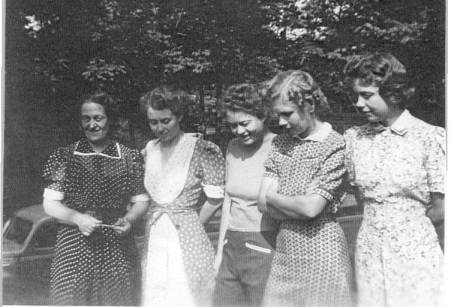 The Jones girls and their mother ca. 1937:
from left, Rhoda, Francis, Rhoda, Muriel and Catherine.
The Jones girls and their mother ca. 1937:
from left, Rhoda, Francis, Rhoda, Muriel and Catherine.